How to keep squirrels out of bird feeders
Keep squirrels out of bird feeders with measured placement, properly fitted baffles and squirrel-resistant designs. Avoid grease, pepper dust and harmful traps.
In short
- Start by measuring the route from nearby trees, railings, fences and ledges to your feeder.
- Audubon recommends placing pole-mounted feeders at least 10 feet from trees, shrubs and other tall structures.
- Use a pole baffle at least 17 inches across, and check its mounting instructions before installation.
- On an NYC balcony without enough clearance, reduce access instead of expecting complete squirrel exclusion.
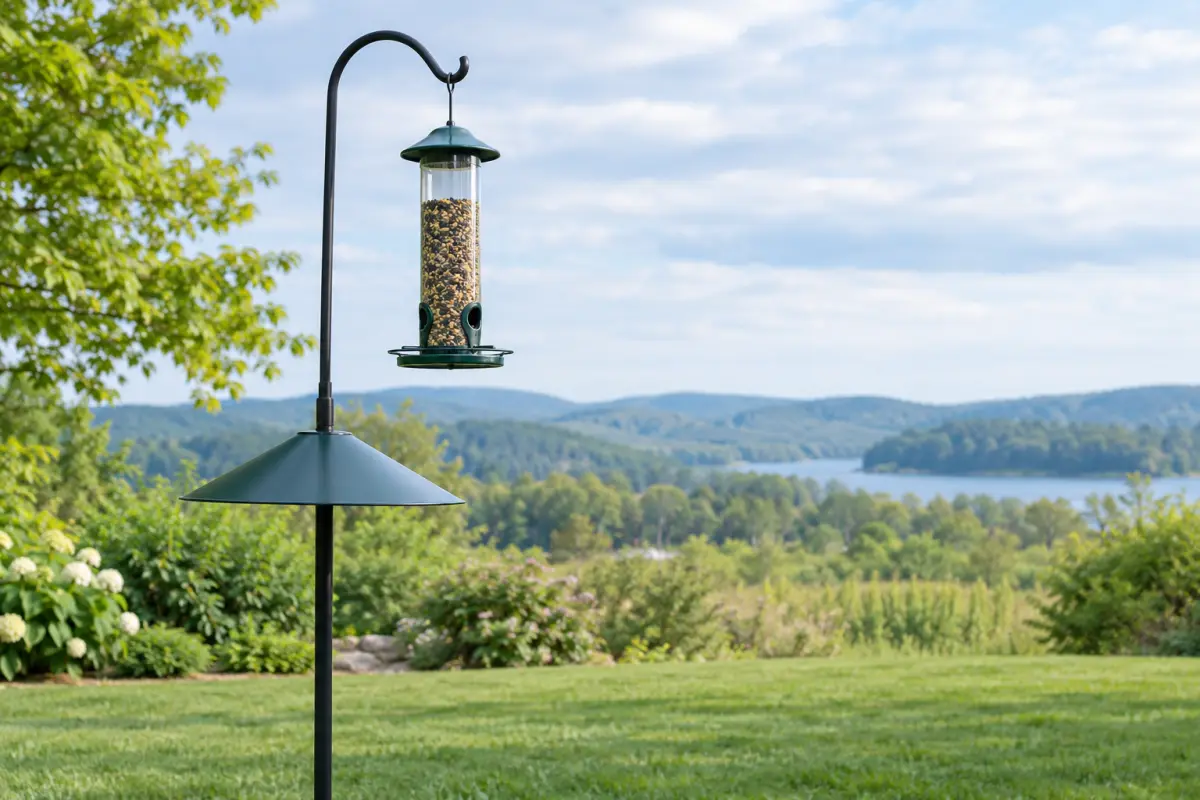
To learn how to keep squirrels out of bird feeders, block their approach with measured placement, a fitted baffle and suitable equipment. Start by finding where they climb, jump or reach from. No setup guarantees complete exclusion, especially on a balcony with nearby railings and ledges.
Find where squirrels reach the feeder
Watch the entire approach before buying equipment. A squirrel climbing a pole needs a different intervention from one jumping off a fence.
Check trees, walls, balcony rails, furniture, hanging brackets and neighboring feeders. Look overhead too: moving a feeder away from a trunk may leave it beneath an accessible branch.
Nebraska Extension describes gray squirrels jumping sideways up to 8 feet and dropping as far as 15 feet onto a target. These are capability estimates, not distances that guarantee success or failure at your home.
Measure the distances instead of guessing. Record horizontal distance and height, then note whether each route was observed or is merely possible.
Use placement and baffles together
Move a pole-mounted feeder into open space when your yard allows it. Audubon's feeding guidance, checked October 23, 2026, recommends at least 10 feet from trees, shrubs and other tall structures.
Fit a baffle (a physical barrier around the pole) beneath the feeder. Audubon specifies a diameter of at least 17 inches. Its squirrel-control guidance places the baffle between 4 and 5 feet above the ground.
Follow the baffle's installation instructions for its mounting point and compatible pole size. A wide barrier cannot help if a squirrel can jump onto the feeder from beside it.
Keep window safety in the placement decision. Audubon's guidance, checked October 23, 2026, advises feeders less than 3 feet from glass or more than 30 feet away. Do not solve squirrel access by creating a collision hazard.
Map the approach with the reach-path worksheet
Fill in this worksheet before changing your setup. The measurements are starting points from Audubon and Nebraska Extension, checked October 23, 2026. They do not guarantee complete exclusion.
| Approach | Record at your home | What the measurement tells you | Humane intervention |
|---|---|---|---|
| Ground to pole | Baffle height: ___ feet; diameter: ___ inches | Audubon recommends mounting between 4 and 5 feet high and using at least 17 inches across. | Fit a compatible baffle and remove nearby objects that bypass it. |
| Sideways jump | Nearest tree, railing, fence or ledge: ___ feet | Audubon recommends at least 10 feet between pole-mounted feeders and tall structures. | Move the pole toward open space, if available. |
| Overhead drop | Branch or structure above feeder: ___; distance: ___ feet | Nebraska Extension reports drops of up to 15 feet onto a target. | Choose a location without an overhead approach instead of trusting a clearance rule. |
| Reach from an anchor | Can the squirrel hold a pole or rail while touching food? ___ | Audubon warns this can bypass weight-activated closures. | Reposition the feeder so access requires loading its mechanism. |
| Mounting constraint | Available space: ___; permitted mounting options: ___ | A balcony may offer no workable clearance zone. | Consider a caged feeder or stop feeding at that location. |
Change one part of the setup, then watch again. Record whether access decreased, continued unchanged or shifted to another route.
Avoid moving the problem into an unsafe location. Keep equipment away from escape routes and places you cannot reach safely for cleaning.
Understand squirrel-resistant versus squirrel-proof feeders
Treat "squirrel-proof" as a claim to examine, not a promise. Cornell Lab of Ornithology says making a feeder completely inaccessible is difficult.
Compare the mechanism with the route in your worksheet. Weight-activated feeders close feeding ports when an animal's weight pulls down a surrounding shroud. Audubon notes that squirrels may bypass this mechanism by reaching from another support.
Caged feeders put a barrier between an animal and the food. They also restrict which birds can reach the feeding area. Check the manufacturer's stated opening dimensions and intended bird sizes before choosing one.
Prefer a clearly described mechanism over an unqualified label. Check required clearance, adjustment instructions, cleaning access and replacement parts. Manufacturer specifications describe intended operation; they do not establish performance at your home.
A worked example for a small Queens balcony
Suppose your inputs are a hopper feeder, Northern Cardinals and a railing within reach of the seed ports. Use the feeder and seed matcher to compare food and feeder compatibility, then use the worksheet to assess squirrel access.
The railing is the immediate problem. A baffle beneath the feeder will not block a squirrel that approaches sideways and eats while holding the rail.
Measure whether another permitted position removes that route. If not, consider a caged design, recognizing that it may also limit access for your intended birds.
Try safflower only as a modest additional measure. Audubon describes it as generally less appealing to squirrels, not universally rejected. Avoid buying more hardware when the mounting constraints remain unchanged.
Use the NYC birding year to explore seasonal reporting patterns instead of assuming a feeder will attract a particular bird. If feeding cannot work safely, explore places to watch birds in NYC instead.
Avoid harmful substances and unreliable deterrents
Skip grease, petroleum jelly and oils on poles or hangers. Cornell warns that grease can impair feathers' waterproofing and insulation. This safety guidance from Cornell Lab was checked October 23, 2026.
Avoid homemade cayenne dust. Audubon identifies uncertainty about capsaicin exposure to animals' eyes. Clemson Extension explains birds' different response to capsaicin, but that does not establish that every exposure is harmless.
Choose mechanical barriers before spicy products. Keep sticky adhesives, glue traps and shock devices out of your feeding setup.
Do not rely on peppermint, garlic or predator scents to keep squirrels away from bird feeders. None of the sources behind this page supports a scent as a dependable deterrent. Keep essential oils and other deterrent substances off seed and feeding surfaces.
Remove spilled food instead of adding a separate squirrel buffet. New York State DEC warns that supplemental wildlife feeding can disrupt natural ecological relationships.
Keep the goal practical: safe bird access with less squirrel access. For a different feeding setup, consult hummingbird feeder placement and cleaning instead of carrying seed-feeder deterrents over to nectar equipment.
- Measure nearby launch points and note any overhead branches.
- Check whether a squirrel can reach the food while holding another surface.
- Match the baffle to the pole and follow its installation instructions.
- Keep grease, loose pepper, adhesives and shock devices away from the feeding station.
- Recheck bird access and squirrel routes after each change.
If you buy through a partner link, we may earn a commission at no extra cost to you. Partners do not see or approve our pages. How we handle advertising.
Questions we get
Should I give squirrels their own feeding station?
Skip diversion feeding as your first solution. New York State DEC warns that feeding wildlife disrupts the balance between wildlife populations and habitat. Adding another food source does not fix the route to your bird feeder.
What should I do if a squirrel bites me?
NYSDOH advises washing any wound thoroughly with soap and water and seeking medical attention right away. It says small rodents such as squirrels get rabies only in rare circumstances; let a doctor or the local health department judge yours. Call 911 for a life-threatening injury or bleeding you cannot control.
Does changing the seed replace a baffle?
No. Audubon describes safflower as less appealing to squirrels, but a food preference is not a physical barrier. Keep measuring access routes, and check whether the birds you want to feed use the replacement food.
Keep reading
How we know
- unl.edu (extensionpubs.unl.edu)
- How to Stop Squirrels From Raiding Your Bird Feeders | Audubon (audubon.org)
- Audubon Guide to Bird Feeding (PDF) (media.audubon.org)
- allaboutbirds.org
- allaboutbirds.org
- clemson.edu (hgic.clemson.edu)
- Frequently Asked Questions About Birds | Audubon (audubon.org)
- ny.gov (health.ny.gov)
- ny.gov (dec.ny.gov)
Seasonal patterns are guides, not promises of a sighting. Check current access rules and conditions before heading out. Give birds space, stay on open paths and avoid disturbing nests or roosts.