Types of bird feeders and the birds they attract
Compare bird feeder types by food, bird access, drainage, cleaning, and spill risk, with practical choices for NYC balconies, windows, and backyards.
In short
- Tube feeders suit small perching birds, while wider hopper and platform feeders give larger birds more room.
- On an NYC balcony, choose a feeder you can retrieve, empty, and clean without leaning over the railing.
- Audubon advises placing feeders less than 3 feet from windows or more than 30 feet away.
- Cornell recommends cleaning seed feeders about every two weeks, or more often during wet weather.
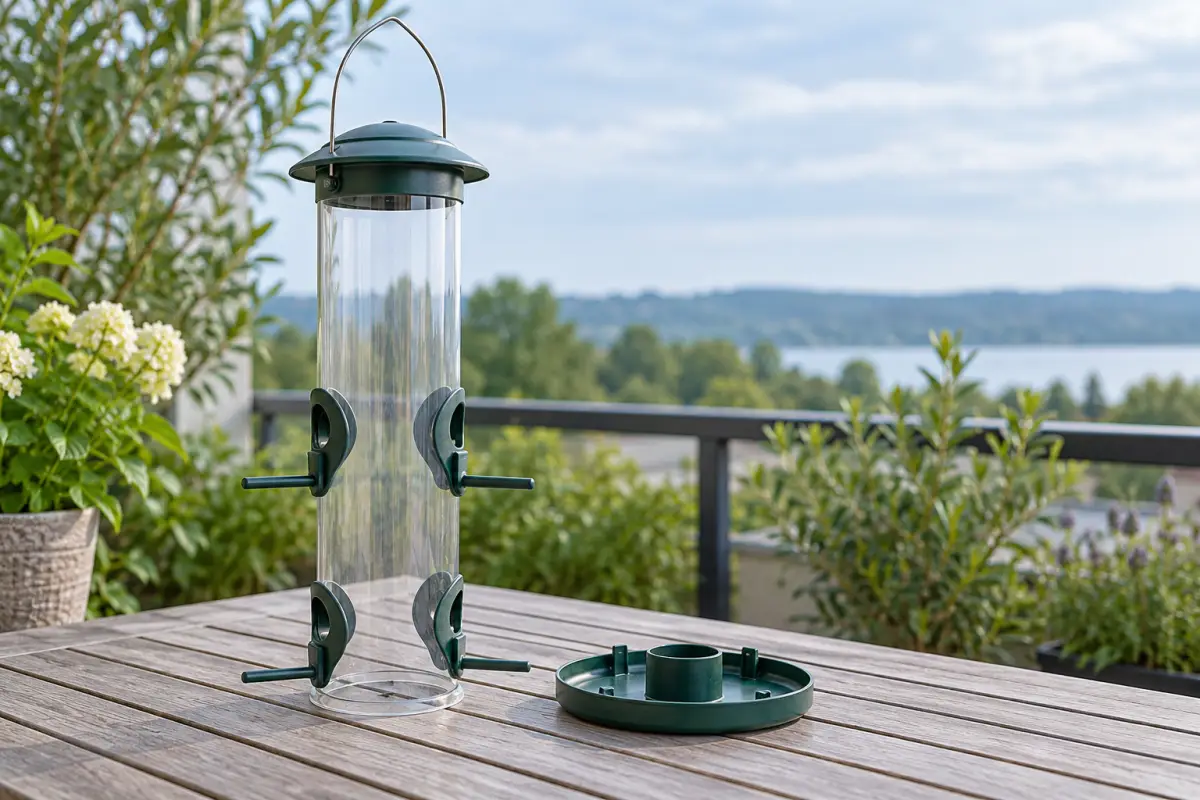
The main types of bird feeders are tubes, hoppers, platforms, suet cages, specialized finch feeders, and window-mounted trays. Choose a feeder by the food it holds, the birds that can reach it, and how easily you can clean it. If you have a small balcony or patio, start with one manageable feeder.
How do tube, hopper, platform and suet feeders differ?
Tube bird feeders hold seed inside a central cylinder with feeding ports and small perches. These perches favor agile, small perching birds like American Goldfinches, Black-capped Chickadees, and House Finches. Longer perches or an attached seed tray allow larger birds to feed from a tube as well.
Hopper feeders store seed in a central reservoir and drop it into a lower trough. Their broad perches fit medium-sized birds like Northern Cardinals and Blue Jays. Project FeederWatch notes that few hoppers are weatherproof, so check the corners for damp seed.
Platform bird feeders are open trays where birds land directly on the feeding area. They welcome many body sizes, including Mourning Doves and native sparrows, but they leave food exposed to rain and droppings.
Suet cages hold blocks of rendered animal fat for clinging birds. Audubon lists woodpeckers, nuthatches, chickadees, and titmice among the birds that use suet cages.
Which foods work with each feeder design?
Start with black-oil sunflower seed for a dependable, all-around option. Audubon's feeding guide says it appeals to the greatest number of birds. Match other foods to the openings of each feeder design.
Bird and food pairings follow Audubon guidance. Construction and cleaning recommendations come from the Cornell Lab of Ornithology, checked October 23, 2026.
| Feeder type | Suitable food | Bird access | Drainage and moisture checks | Cleaning access | Spill management and placement |
|---|---|---|---|---|---|
| Tube | Black-oil sunflower; safflower if ports allow | Small perching birds, including finches, chickadees, and nuthatches | Check base drains and seed trapped below the lowest ports | Remove base; brush tube and ports | Expect hulls; a removable catcher adds cleanup and landing space |
| Hopper | Black-oil sunflower, safflower, cracked corn | Broad perches suit cardinals, jays, and smaller birds | Inspect troughs and reservoir corners despite the roof | Open reservoir; scrub corners and troughs | Sorting can scatter seed; allow for the loaded weight of the feeder |
| Platform or tray | Black-oil sunflower, white millet, cracked corn | Open access for sparrows, juncos, doves, and other seed eaters | Prefer a screened bottom over a solid floor | Lift out screen; remove debris and scrub | Broad feeding area means more cleanup; difficult above neighbors |
| Suet cage | Suet cakes | Clinging birds, especially woodpeckers | Check food condition and heat exposure | Open cage; scrub wire intersections | Few seed hulls, but softened fat can create mess |
| Finch or Nyjer | Nyjer seed | Tiny ports or fine mesh favor small finches | Inspect damp seed and fabric socks for clumping | Open tube fully or wash removable sock | Small shells still accumulate; sweep regularly |
| Window-mounted tray | Sunflower or safflower; kernels in small, frequently checked portions | Depends on opening size and landing area | Keep drainage holes clear; inspect exposed food | Choose a detachable tray | Debris may fall down the building; mount only where safely retrievable |
Finch bird feeders use tiny ports or mesh socks designed specifically for slender Nyjer thistle seed. Standard tube ports let tiny Nyjer seed spill out.
Keep sunflower hearts and chips out of tube feeders where moisture collects, Cornell advises. Removing hulls reduces shell debris, but you still need to inspect the seed regularly for mold.
Nectar and fruit require separate equipment. Audubon lists hummingbirds and orioles for nectar feeders, while orioles and tanagers also visit fruit dishes. Read our hummingbird feeder guide before adding nectar.
Which designs are manageable on a balcony?
Choose a small tube feeder or a detachable window tray if you have limited space. Make sure you can reach every part safely from inside the balcony railing. A suet cage also works well on a balcony, provided you can clean the area beneath it.
Check your lease and building rules before hanging anything outside. Compact feeders can still drop seed hulls onto neighbors below. Seed trays catch loose hulls, but they also require frequent sweeping and washing.
A larger reservoir holds more seed and adds weight when full, but it does not change which birds can visit. Pick a feeder size based on what you can clean and refill safely.
Measure the distance to your windows before hanging any feeder. Audubon recommends placing feeders closer than 3 feet to a window or farther than 30 feet away to reduce fatal collisions. That guidance was checked October 23, 2026. Cornell's All About Birds explains that a bird taking off from a feeder that close will not be at top speed if it hits the glass.
Check surrounding windows as well. Monitor suction cups on window models regularly to make sure the bond stays secure.
How do I compare cleaning access and spill risk?
Look for removable bases and feeding ports you can take apart. Skip any model with tight corners your cleaning brush cannot reach.
The Cornell Lab of Ornithology recommends cleaning seed feeders every two weeks. Clean them more frequently during periods of wet weather or heavy bird traffic. Cornell cleaning guidance, checked October 23, 2026, advises taking the feeder apart and washing it in a hot dishwasher or by hand, with soap and boiling water or a dilute bleach solution, then rinsing and drying it before refilling.
Inspect the seed between washings. Discard wet or clumped seed immediately, and never pour fresh seed on top of damp food. Check the drainage holes after rain, because clogged holes trap water at the bottom of the reservoir.
Consider how much waste will fall to the ground. Open trays allow birds to kick seed in all directions, while tube feeders drop shells directly below the perches. NYC Parks warns that leftover feed can attract rodents. Sweep fallen hulls regularly, and reduce the amount of seed you put out if birds leave leftovers.
For suet, use a coated wire cage that holds the cake firmly. Cornell notes that raw suet spoils quickly at temperatures above freezing. Rendered suet keeps much better, Cornell adds, but it can still soften in warm weather.
A worked example: a balcony feeder for goldfinches
Suppose you want to attract American Goldfinches to an apartment balcony in Queens. Enter American Goldfinch in the feeder and seed matcher and compare the foods and feeder types it lists. A small mesh finch feeder or a specialized Nyjer tube keeps seed waste low.
Next, check your physical space. Make sure you can hang the feeder within 3 feet of your balcony window to follow Audubon recommendations. Verify that you can unhook the feeder and dismantle its base over an indoor tray without leaning outside. Hang a shallow tray below the tube to catch hulls before they reach the balcony below.
Consult the NYC month-by-month birding guide to see when American Goldfinches are reported in your area. In our report index from the eBird Observation Dataset, the species is common in NYC reports in April–May, July–September and November–December, and fairly common in the other months. If unfamiliar birds visit the feeder, examine bill shape, body size, and wing markings. Use the New York bird identification guide to compare look-alike species, such as female House Finches or Pine Siskins.
- Match the food to the feeder ports and the birds you want to attract.
- Confirm that the base, ports, and interior corners are accessible for scrubbing.
- Choose drainage that stays open and a tray you can remove easily.
- Plan where spilled seed and hulls will land before mounting the feeder.
- Measure the distance from nearby windows and check building rules.
If you buy through a partner link, we may earn a commission at no extra cost to you. Partners do not see or approve our pages. How we handle advertising.
Questions we get
Are the tiny black pieces under a Nyjer feeder wasted seed?
Often they are empty shells. Cornell explains that birds crack open Nyjer hulls before eating the tiny kernel inside. Check the feeder reservoir for damp clumps, but expect a pile of discarded shells beneath the perches.
Will squirrels ignore a finch feeder?
Not always. Cornell notes that squirrels usually show little interest in Nyjer seed, but that is not a guarantee. Mount feeders out of leaping range.
Will an upside-down suet feeder exclude starlings?
It limits them. Cornell's All About Birds notes that starlings cannot feed hanging upside down, while woodpeckers, chickadees and nuthatches reach the suet easily.
Does a larger seed reservoir mean less maintenance?
No. Project FeederWatch notes that few hopper feeders are weatherproof. Large supplies of seed can spoil or mold before birds finish them. Choose a capacity you can inspect and empty every few days.
Keep reading
How we know
- allaboutbirds.org
- feederwatch.org (cdn.feederwatch.org)
- allaboutbirds.org
- audubon.org (media.audubon.org)
- allaboutbirds.org
- allaboutbirds.org
- allaboutbirds.org
- Wildlife in New York City | NYC Parks (nycgovparks.org)
Seasonal patterns are guides, not promises of a sighting. Check current access rules and conditions before heading out. Give birds space, stay on open paths and avoid disturbing nests or roosts.