Compact binoculars for birding: what you gain and lose
Compare 8x25, 8x30 and 8x32 binoculars for NYC birding, with Audubon's spec guidance, eyeglass fit checks and practical portability trade-offs.
In short
- Start with 8x30 or 8x32 for regular birding walks; choose 8x25 when pocket storage makes the difference between carrying binoculars and leaving them home.
- Audubon's minimum angle of view, 6.5° or 341 feet at 1,000 yards, applies to compact and pocket pairs as much as to full-size ones.
- Audubon says binoculars designed for birders offer 15 to 20 mm of eye relief, but your glasses and eyecup fit determine whether you see the full view.
- Pocket binoculars save space, while their smaller exit pupils demand more precise eye placement and offer less flexibility in dim light.
Common binocular sizes, side by side
Computed from magnification and objective. Your choice in the chooser is highlighted.
| Size | Exit pupil | Relative brightness | Twilight factor | On Audubon's birding list |
|---|---|---|---|---|
| 7x35 | 5 mm | 25.0 | 15.7 | Yes |
| 8x25 | 3.13 mm | 9.8 | 14.1 | No |
| 8x32 | 4 mm | 16.0 | 16.0 | Yes |
| 8x42 | 5.25 mm | 27.6 | 18.3 | Yes |
| 10x25 | 2.5 mm | 6.3 | 15.8 | No |
| 10x42 | 4.2 mm | 17.6 | 20.5 | No |
| 10x50 | 5 mm | 25.0 | 22.4 | No |
| 12x50 | 4.17 mm | 17.4 | 24.5 | No |
Exit pupil, in millimeters
The dot at the end of each bar is drawn to scale with the exit pupil.
Audubon's minimum for birding: 6.5° (341 ft at 1,000 yd).
Formulas: exit pupil = objective ÷ magnification; relative brightness = exit pupil²; twilight factor = √(magnification × objective). Birding sizes and the 52.5 ft per degree conversion: National Audubon Society, “How To Choose Your Binoculars”.
The short answer
The best compact binoculars for birding balance carrying convenience with a view you can acquire quickly. Start with an 8x30 or 8x32 pair for regular walks, especially under tree canopies. Choose an 8x25 model when pocket storage matters more than easy eye placement or dim-light viewing.
These suggestions compare format sizes across brands without ranking models. Published specifications show physical carrying differences, though they cannot measure individual comfort or optical clarity.
Use the binocular chooser as a rule of thumb for your priorities. For a wider starting point across all sizes, see our guide to choosing birding binoculars.
What the numbers mean
The first number is magnification. Each format discussed here makes a bird appear eight times closer. The second number is the objective diameter, which measures the width of each front lens in millimeters.
An exit pupil is the beam of light leaving each eyepiece. Cornell Lab's All About Birds explains that compact binoculars have narrower exit pupils than full-size pairs. That narrower beam requires more precise eye alignment.
Field of view describes the width of the scene visible through the binoculars. A wider view helps you find and follow a moving songbird. Front lens size alone does not set this width, which varies among individual models.
Eye relief is the maximum distance your eye can sit behind the eyepiece and still see the full view. Audubon says binoculars designed for birders offer 15 to 20 mm of eye relief. Eyeglass lenses hold your eyes farther back, making this measurement essential if you wear glasses.
How do 8x25, 8x30 and 8x32 differ?
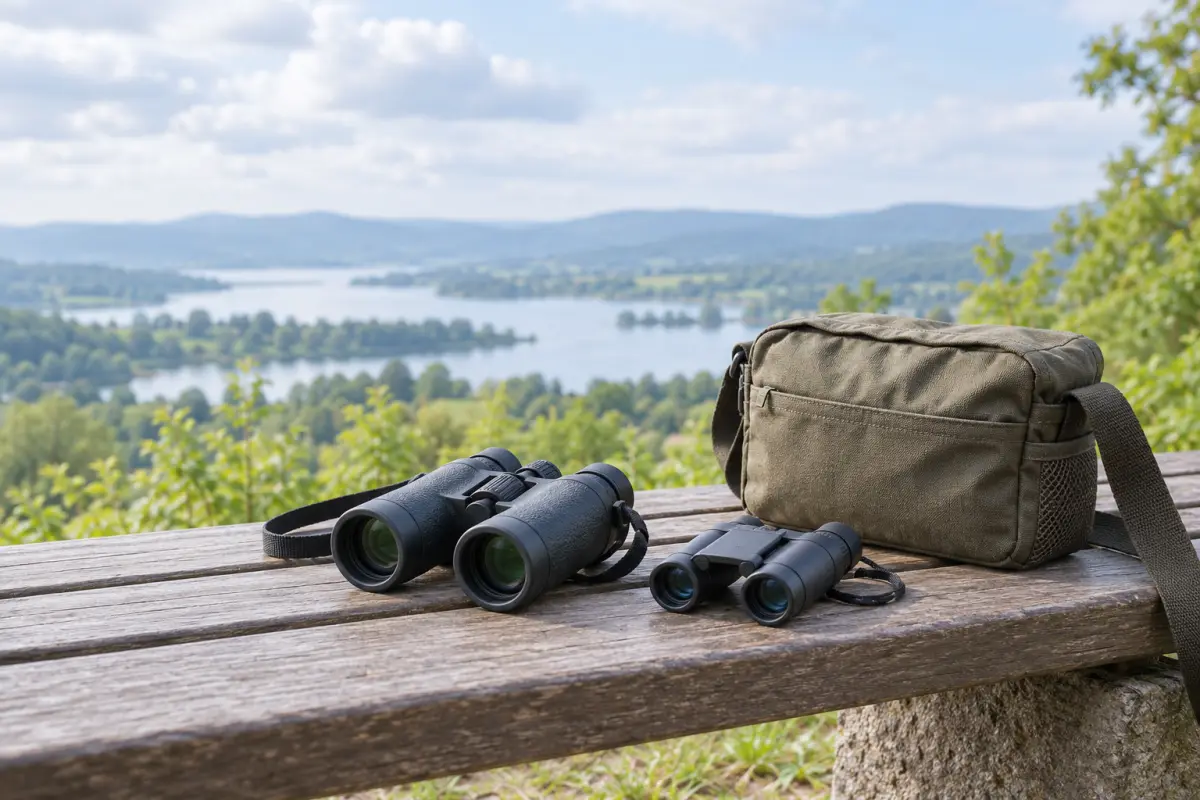
In this guide, compact means the mid-size 30 to 32 mm class. Pocket binoculars are smaller, folding designs with 25 mm objective lenses. These names are practical buying categories, not formal industry standards.
An 8x30 pair and an 8x32 pair sit in the same practical buying bracket. Compare their listed measurements, viewing angles and focus controls directly. A two-millimeter difference in objective glass does not guarantee lower weight.
An 8x25 design requires a bigger compromise on light gathering. Cornell Lab's All About Birds notes that 25 mm pocket lenses have far less glass area than 42 mm full-size lenses. Audubon adds that objectives under 30 mm are not bright enough to show all the detail you need in poor light.
Which fits NYC birding
Choose compact binoculars for a dedicated park walk when steady handling matters. Take pocket binoculars when you want optics in an everyday commuter bag for unexpected sightings.
Under a dense wooded canopy, a wider exit pupil gives your eyes more leeway as light levels drop. An 8x30 or 8x32 pair gives you a practical balance between pocket frames and full-size viewing ease.
Along bright waterfronts, an 8x25 model works well during daylight hours. A smaller front lens does not reduce eight-power magnification, so distant birds appear equally enlarged. Distance across open water remains a separate challenge regardless of binocular size.
For balcony or backyard birding, prioritize comfortable eyecups and a smooth focus wheel. True pocket folding adds little value if the binoculars stay on a windowsill. You can review full-size options in our 8x42 versus 10x42 guide.
When does reduced weight outweigh a smaller objective?
Choose a lighter pocket pair when physical bulk causes you to leave your optics at home. Crowded subway rides, daily commutes and quick walks justify carrying a smaller 8x25 frame.
Stick to mid-size compacts when birding is the main goal of your outing. Finding quick warblers among leaves requires fast eye placement that saves you frustration over several hours.
Test your complete carrying gear before deciding on weight. A padded case, sturdy neck strap and quick-access bag pocket often influence daily comfort more than a few ounces on a spec sheet.
What to check before you buy
Treat manufacturer specifications as carrying and fit data, not hands-on test results. Check whether published dimensions describe the open body or the folded one.
Read stated weight, eye relief and field of view on each maker's spec sheet. Check the field of view against Audubon's minimum of 6.5°, or 341 feet at 1,000 yards. Two pairs with the same front lens can differ in viewing width, so the objective alone cannot tell you how much scenery you take in.
Which compact designs may be awkward with eyeglasses?
Examine short-eye-relief designs and double-hinge pocket binoculars with extra care. Published specifications cannot tell you how a specific barrel will align with your prescription frames and facial structure.
Pocket hinges adjust the physical spacing between the two barrels. Align both barrels to match your eye spacing before evaluating the image. Audubon notes that imperfect pupil alignment can cause image blackout, especially for eyeglass wearers.
Retract the eyecups completely before looking through the lenses while wearing glasses. Verify that you can see the full circular picture edge to edge without pressing your eyeglasses against the ocular glass.
Lift and lower the binoculars several times in succession. Reject any model that forces you to hunt for the image circle, regardless of what its spec sheet promises.
How should I compare folded dimensions and carrying weight?
Compare open dimensions against open dimensions, and folded measurements against folded measurements. Ask a retailer for true folded dimensions or measure the closed unit directly before relying on pocket fit.
Leave adequate space for the protective pouch and protruding control knobs. A binocular that fits into a pocket too tightly can snag during a sudden sighting.
Check the weight of the binoculars together with the strap, lens caps and case you carry. Makers do not all state weight the same way, so compare like with like.
Turn the central focus wheel while maintaining a natural, relaxed grip. Try turning the wheel while wearing outdoor gloves, because compact controls can feel cramped during cold weather.
Mistakes to avoid
Do not assume that pocket binoculars are easier for beginners to use. Their smaller bodies and narrow exit pupils demand more deliberate alignment than full-size optics. Our beginner binocular guide explains basic fit checks in detail.
Do not buy higher magnification to compensate for a smaller front lens. Keep magnification, field of view, eye relief and physical ergonomics distinct as you weigh different specifications.
Audubon's buying guide advises against zoom and image-stabilized binoculars, pointing to weight, reduced brightness and narrower fields of view. Treat this caution as guidance on binocular categories, not a review of individual models.
Examine weather resistance separately from physical size. Audubon says binoculars costing more than $200 should be waterproof and nitrogen purged, so they do not fog up in humid conditions.
Never look directly at the Sun through binoculars. NASA warns that viewing the bright Sun through binoculars without a special-purpose solar filter instantly causes severe eye injury. Plan your viewing direction before raising the eyepieces, especially when scanning bright skies.
- Compare 8x25 pocket storage against 8x30 or 8x32 handling.
- Check whether published dimensions describe open or folded binoculars.
- Compare stated binocular weight separately from the loaded case and strap.
- Check field of view against Audubon's 6.5° or 341-foot guideline.
- Try eye relief and eyecups with your usual glasses.
- Operate the focus wheel and hinges with your usual outdoor gloves.
- Require waterproofing and nitrogen purging above $200, following Audubon's guidance.
If you buy through a partner link, we may earn a commission at no extra cost to you. Partners do not see or approve our pages. How we handle advertising.
Questions we get
Should I replace working 8x42 binoculars with a compact pair?
Only if carrying size or weight regularly stops you using them. A compact pair can complement your existing binoculars for everyday trips. It does not automatically improve the view or replace the advantages of larger objectives in dim light.
Does a smaller objective mean less magnification?
No. All three formats discussed here magnify eight times. The second number describes the front lens diameter, not magnification. An 8x25 therefore does not make a bird smaller than an 8x32 simply because its objectives are smaller.
Can I judge optical quality from a spec sheet?
No. A spec sheet lists the maker's figures, not measured sharpness, glare control, color rendition or durability. Use it to narrow your carrying and fit requirements, then compare the view and controls yourself.
Keep reading
How we know
- Conquer Image Blackout Forever! | Audubon (audubon.org)
- allaboutbirds.org
- How To Choose Your Binoculars | Audubon (audubon.org)
- Total Solar Eclipse Safety - NASA Science (science.nasa.gov)
Seasonal patterns are guides, not promises of a sighting. Check current access rules and conditions before heading out. Give birds space, stay on open paths and avoid disturbing nests or roosts.