Binoculars for beginner birders: what to look for
Start with 8x binoculars, then compare field of view, eyeglass fit, focus and weight. Use a spec-sheet checklist and a practical return-period checklist.
In short
- Start with 8x42 binoculars for general birding, or try 8x32 if carrying less weight matters more.
- Audubon recommends at least 6.5 degrees of view, equivalent to 341 feet at 1,000 yards.
- Audubon describes birding binoculars with 15 to 20 mm eye relief, but glasses-on fit still needs checking.
- Compare handling before extra magnification: 10x enlarges hand movement as well as the bird.
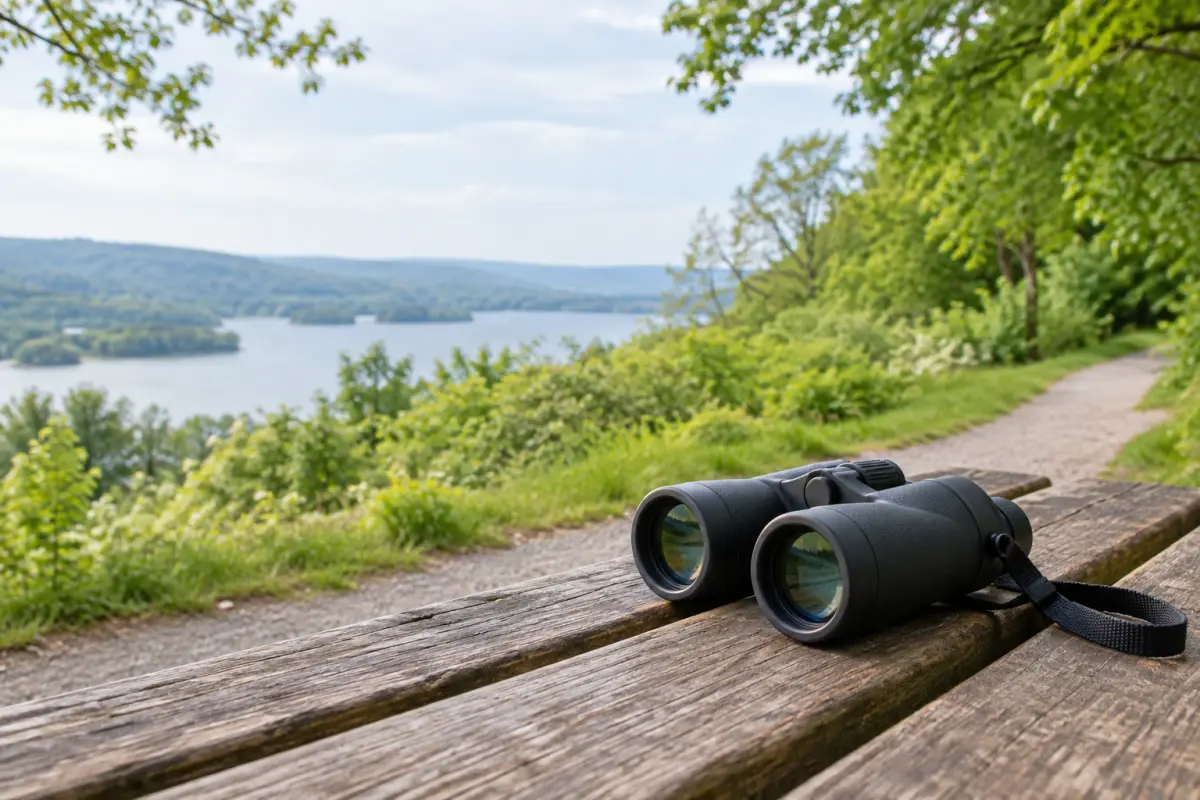
Common binocular sizes, side by side
Computed from magnification and objective. Your choice in the chooser is highlighted.
| Size | Exit pupil | Relative brightness | Twilight factor | On Audubon's birding list |
|---|---|---|---|---|
| 7x35 | 5 mm | 25.0 | 15.7 | Yes |
| 8x25 | 3.13 mm | 9.8 | 14.1 | No |
| 8x32 | 4 mm | 16.0 | 16.0 | Yes |
| 8x42 | 5.25 mm | 27.6 | 18.3 | Yes |
| 10x25 | 2.5 mm | 6.3 | 15.8 | No |
| 10x42 | 4.2 mm | 17.6 | 20.5 | No |
| 10x50 | 5 mm | 25.0 | 22.4 | No |
| 12x50 | 4.17 mm | 17.4 | 24.5 | No |
Exit pupil, in millimeters
The dot at the end of each bar is drawn to scale with the exit pupil.
Audubon's minimum for birding: 6.5° (341 ft at 1,000 yd).
Formulas: exit pupil = objective ÷ magnification; relative brightness = exit pupil²; twilight factor = √(magnification × objective). Birding sizes and the 52.5 ft per degree conversion: National Audubon Society, “How To Choose Your Binoculars”.
The short answer
Our rule of thumb for a beginner is an 8x42 pair that fits your face and lets you find birds quickly. Choose a wide field of view, comfortable eyecups, and a smooth focus wheel before considering higher magnification. Try 8x32 binoculars if carrying less weight on foot matters more to you.
Audubon includes both configurations among its recommended birding sizes. Neither size fits every face, and specification sheets cannot prove optical quality.
Start with the binocular chooser's woods setting as a practical baseline. Compare actual models in person and test their fit before making a purchase.
What the numbers mean
Magnification is the first number in a specification: 8x makes a bird appear eight times larger than your unaided view. Objective diameter is the second number: 42 means the front lenses measure 42 millimeters across.
Larger objective lenses bring a weight trade-off. Audubon notes that binoculars with objectives above 42 mm are too heavy for most people to carry all day. Objectives below 30 mm are not bright enough to show all the detail in poor light.
Exit pupil is the width of the light beam leaving each eyepiece. The optics table calculates exit pupil by dividing objective diameter by magnification. This number provides a brightness comparison, while optical coatings and glass quality determine image clarity.
Field of view measures the horizontal width of the scene visible through the optics. A wider view helps you locate and follow an active bird among leafy branches. Audubon recommends a baseline of at least 6.5 degrees, which equals 341 feet at 1,000 yards.
Eye relief is the distance your eye can sit behind the eyepiece lens while still seeing the entire circular view. Audubon suggests 15 to 20 mm for birding binoculars. Your facial contours and eyeglass frames still determine whether you see the complete picture comfortably.
How to build a shortlist
Read each candidate's spec sheet against the Audubon baselines above: field of view, eye relief, a center focus knob, and waterproofing above the $200 line. Prioritize close focusing if you watch birds at nearby feeders, and choose a total weight you can carry comfortably.
Manufacturer specifications are claims, not test results. Sparrow Line does not test or rank models, so confirm the exact model's figures before ordering and judge the view in your own hands.
Which fits NYC birding
Start with 8x magnification for wooded park walks. Audubon explains that 10x magnifies hand tremor more noticeably than 8x. A wider view also makes finding small songbirds among moving leaves significantly easier.
Consider 10x if distant birds across open water dominate your birding outings, keeping in mind that 10x42 is not on Audubon's list of birding sizes. Compare both magnifications on the same target before deciding. Extra reach helps only when you can hold the image steady without fatigue.
Read our 8x42 versus 10x42 comparison to evaluate that choice. For mixed birding across city green spaces, begin with the configuration you handle most easily. Buy for your everyday walks where you spend the most time.
For a balcony or small backyard, check minimum focusing distance before buying. Birds landing closer than that distance will appear blurry. Review NYC birding places to match your optical needs to the habitats you plan to explore.
What to check before you buy
Hold each model in your natural viewing position. Reach the focus wheel without altering your grip, and confirm that the body feels balanced in your hands.
Evaluate weatherproofing claims independently from retail price. Audubon says binoculars costing more than $200 should be waterproof and nitrogen purged, so they do not fog up in humid weather.
How can I check fit with eyeglasses?
Wear the glasses you normally use outdoors when trying binoculars. Follow Audubon's guidance by starting with the eyecups fully twisted down.
- Adjust the hinge until both eyepiece circles merge into a single round view.
- Look for the outer edge of the view without pressing the eyepieces hard against your lenses.
- Move your gaze across the image and check for dark shadows or blackouts around the edges.
- Verify adequate clearance so the eyecup edges do not rub or scratch your eyeglass coatings.
- Lift the binoculars repeatedly from chest height to make sure your eyes align naturally with the view.
Set the diopter according to the manufacturer's directions to balance focus between your eyes. Recheck your view afterward. Frame thickness and facial shape influence real-world comfort alongside published eye-relief figures.
What should I verify during the retailer's return period?
Read the return policy before paying for your binoculars. Confirm the return deadline, packaging rules, potential restocking fees, and whether outdoor testing is permitted.
New York's Division of Consumer Protection states that retail stores must clearly post their refund policies. When no policy is posted, it says you have 30 days from purchase to get a full refund or credit, with proof of purchase, if the item is unused and undamaged. Do not assume every seller provides an automatic 30-day trial period.
Complete these practical checks early in your return window:
- Turn the central focus wheel through its full travel and check that the hinge holds your eye spacing.
- Focus on stationary objects at near and far distances in natural outdoor daylight.
- Rest your eyes if you notice double images or experience strain while combining the circles.
- Contact the seller immediately about defects. Do not attempt internal adjustments yourself.
A simple home check cannot measure optical alignment with scientific precision. Keep your purchase receipt, original packaging, and accessories until you decide to keep the binoculars.
Mistakes to avoid
Avoid choosing binoculars based solely on maximum magnification or an "HD" label. Spec sheets provide physical measurements like size and weight. They cannot confirm optical sharpness or color fidelity.
Audubon advises against zoom and image-stabilized binoculars for birding. Audubon notes that they are heavy, give up a lot of brightness and have a much-reduced field of view. For a first purchase, compare standard fixed-power models.
Practice spotting a bird with your unaided eyes before raising the eyepieces to your face. Use our bird identification guide to evaluate multiple field marks together. Binoculars reveal fine plumage details. Patient observation confirms the identification.
Never look at the sun through binoculars. The American Academy of Ophthalmology warns against viewing the sun through unfiltered binoculars and notes that even a short look without proper protection can permanently damage the retina. Lower your optics immediately whenever a bird flies toward the sun.
- Compare 8x42 with 8x32 before choosing higher magnification.
- Check field of view against Audubon's 6.5-degree baseline.
- Check eye relief and retractable eyecups with your usual glasses.
- Confirm the hinge adjusts to your eye spacing.
- Compare close focus with the distance to your usual viewing targets.
- Check weight, waterproofing and nitrogen purging on the exact model's specifications.
- Read return conditions before paying and keep the receipt.
If you buy through a partner link, we may earn a commission at no extra cost to you. Partners do not see or approve our pages. How we handle advertising.
Questions we get
Can two people share beginner binoculars?
Yes, provided the hinge and eyecups fit both people. Each person may need a different hinge position and diopter setting. Check that both users can reach the focus wheel and see the full circular field before buying.
Does an HD label prove one model is better?
No. A label is not a measurement and does not guarantee better sharpness, contrast, or color. Published specifications help you evaluate dimensions and weight, but in-person viewing shows the clarity for your eyes.
Should I remove my glasses to use binoculars?
Try your normal viewing setup first. Audubon advises retracting the eyecups with glasses and extending them without glasses. Choose the arrangement that gives you a comfortable, complete view; an eye-relief specification alone cannot establish fit.
Keep reading
How we know
Seasonal patterns are guides, not promises of a sighting. Check current access rules and conditions before heading out. Give birds space, stay on open paths and avoid disturbing nests or roosts.